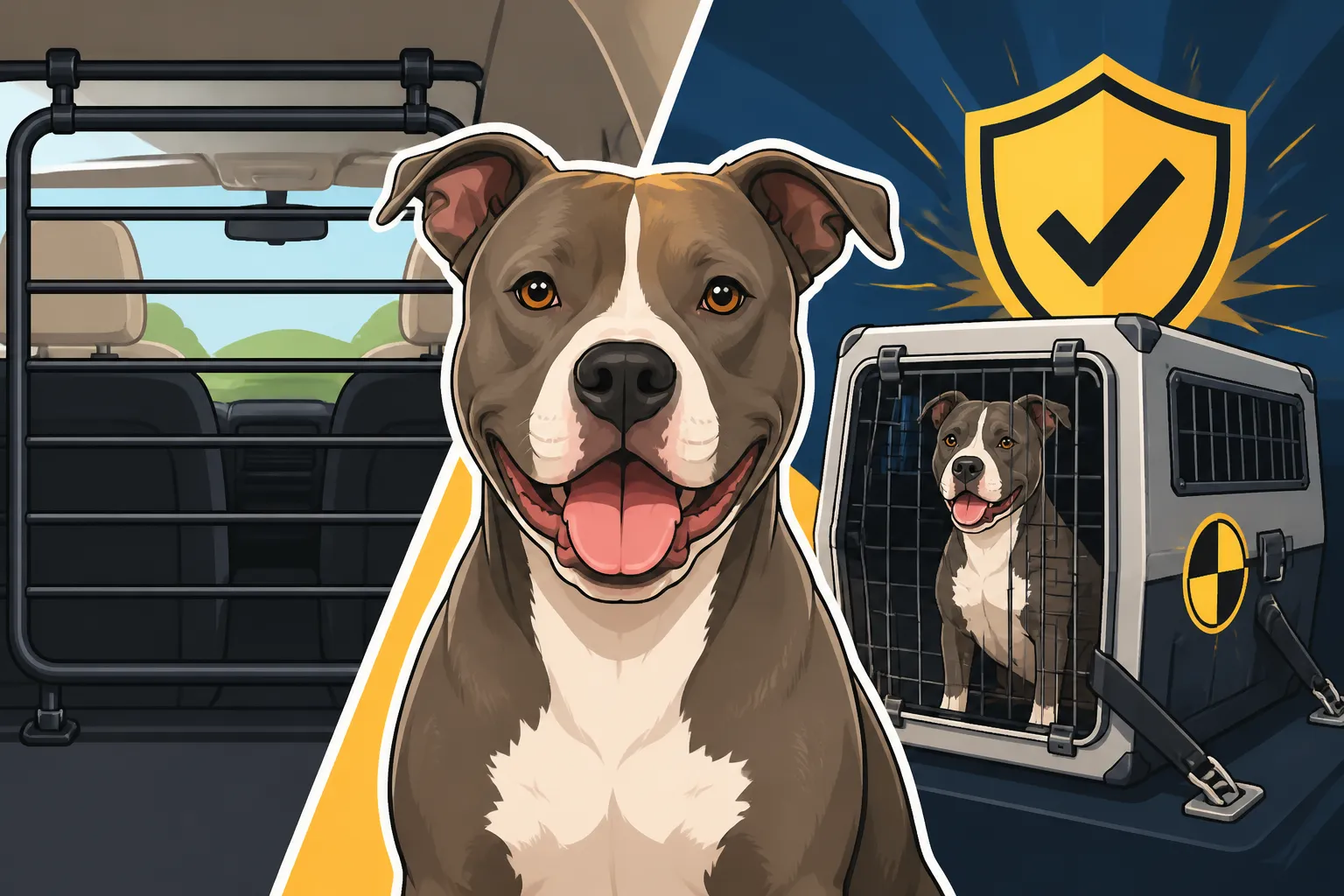
Pit Bull Car Barriers and Crash-Tested Crates
It's a familiar scenario for many Pit Bull owners: you love your powerful, energetic companion, but the thought of safely transporting them in the car can bring on a wave of anxiety. You worry not only about them being a distraction, but more importantly, about their safety – and yours – if there's a sudden stop or, heaven forbid, an accident. This comprehensive guide will walk you through the essential considerations for Pit Bull car barriers and crash-tested crates, helping you choose the best solutions for secure and stress-free travel.
Why Standard Restraints Often Fall Short for Pit Bulls
Many people assume a regular harness or leash attached to a seatbelt will suffice for car travel. While these might offer a modicum of restraint for smaller, less powerful dogs, they often prove woefully inadequate for a muscular and determined Pit Bull. The sheer strength and build of these dogs require a higher standard of safety equipment, a reality that often frustrates owners who have tried multiple "universal" solutions only to find them lacking.
The Limitations of Basic Seatbelt Harnesses
You've probably seen them – the harnesses that promise to keep your dog secure by clipping into a seatbelt buckle. While the idea is good, the execution for a dog with the physical attributes of a Pit Bull can be deeply flawed. A basic fabric harness, even one marketed as "car safe," often isn't designed to withstand the immense forces generated by a dog like a Pit Bull in a collision. We're talking about a dog that can easily pull 50-70 pounds or more, with dense muscle mass. In a sudden stop, that weight becomes a missile. These harnesses can stretch, fray, or even tear, leading to your dog being violently thrown within the vehicle. Beyond that, the hardware – the buckles, clips, and D-rings – on many standard harnesses simply aren't engineered for impact. They can bend, break, or release under pressure, leaving your beloved companion vulnerable. It's not just about restraining them; it's about protecting them from the very thing the harness is supposed to prevent.
Then there's the entanglement risk. Even if the harness holds, a Pit Bull can become tangled in the seatbelt webbing or the harness itself, causing injury during or after an impact. Imagine the panic and potential injury if your dog is caught up in a twisted mess of straps after an emergency maneuver. These harnesses are often designed for distraction prevention more than true crash protection, and for a dog with the determination of a Pit Bull, even the distraction prevention can be hit or miss. Owners often report their clever Pit Bulls wriggling out of or chewing through these lesser restraints, leaving them back at square one, feeling like they've wasted money and still haven't solved the core problem of safe transport. It’s a challenge that many who own powerful breeds can relate to, constantly searching for gear that truly matches their dog's strength and intelligence.
The Danger of Unrestrained Travel
Beyond the inadequacy of many common restraints, allowing your Pit Bull to travel unrestrained poses a multi-faceted danger to everyone in the vehicle. First and foremost, an unrestrained dog is a massive distraction. Whether they're trying to lick your ear while you're driving, scrambling onto your lap, or barking wildly at something outside the window, their unpredictable movements can draw your attention away from the road for crucial seconds. That fleeting moment of distraction can have catastrophic consequences, especially on busy highways or in unexpected traffic situations.
More critically, in the event of an accident or even just a sudden, hard brake, an unrestrained Pit Bull becomes an unguided projectile. Physics dictates that an object's force is a product of its mass and acceleration. A 60-pound Pit Bull traveling at 30 mph can exert thousands of pounds of force upon impact. This isn't just a risk to the dog; it's a severe threat to human occupants. Imagine the force of a dense, muscular dog hitting a human passenger or the back of a seat. Injuries can range from severe bruising and broken bones to internal trauma. The dog itself is also at extreme risk of severe, life-threatening injuries, as they can hit dashboards, windows, or be crushed by collapsing seats. It's a stark reality, but one that needs to be faced when considering how to keep everyone safe. The emotional toll of an injured pet, let alone a human injury caused by an unrestrained pet, is something no owner wants to experience. This is why solutions like car barriers and crash-tested crates are not just conveniences, but critical safety measures for Pit Bull owners.
Choosing the Right Car Barrier for Your Pit Bull
For many Pit Bull owners, especially those who prefer to keep their dog in the cargo area of an SUV or hatchback, a robust car barrier is the go-to solution. It creates a safe, contained space, minimizing distractions and preventing your dog from becoming a projectile in the passenger cabin. However, not all barriers are created equal, especially when dealing with a powerful and sometimes persistent Pit Bull.
Types of Car Barriers and Their Pros and Cons
When it comes to car barriers, you'll generally encounter a few main types, each with its own set of advantages and drawbacks, particularly when matched against a Pit Bull's strength and ingenuity.
1. Mesh Barriers: These are typically fabric-based, often stretching between headrests or attaching with hooks and bungee cords.
- Pros: Lightweight, inexpensive, easy to install and remove, can block some visual distraction.
- Cons: Absolutely not crash-tested or designed for impact containment. A determined Pit Bull can easily push through, chew through, or even jump over these. They offer minimal physical restraint and are primarily for minor distraction prevention, which, let's be honest, often isn't enough for a high-energy Pit Bull.
- Suitability for Pit Bulls: Very low. These are best for small, calm dogs, or as a very temporary solution. For a Pit Bull, they offer a false sense of security.
2. Tension-Mounted Metal Grate Barriers: These barriers typically feature adjustable metal bars that create a rigid grid, expanding to fit snugly between the floor and ceiling or across the width of the cargo area.
- Pros: More robust than mesh, provides a physical barrier, usually affordable.
- Cons: Installation can be tricky to get truly secure. A powerful Pit Bull might be able to rattle, dislodge, or even bend the bars if not perfectly tensioned. Can sometimes leave small gaps at the sides that a clever Pit Bull might exploit.
- Suitability for Pit Bulls: Moderate, if incredibly well-installed and your Pit Bull isn't an escape artist. Regular checks on tension are crucial.
3. Vehicle-Specific (OEM or Aftermarket) Cargo Area Dividers: These are often custom-designed to fit a specific make and model of vehicle, typically anchoring into existing points in the car's frame or cargo area.
- Pros: Excellent fit, very sturdy and secure, often designed to integrate seamlessly with the vehicle's interior. Provides a strong, reliable physical barrier.
- Cons: Can be significantly more expensive. Installation may require some tools or professional help. Not easily transferable between vehicles.
- Suitability for Pit Bulls: High. These offer the best level of containment for Pit Bulls in the cargo area, significantly reducing distraction and providing a much better safety barrier than mesh or generic tension rods.
Here's a quick comparison:
| Barrier Type | Material | Installation | Pros | Cons | Pit Bull Suitability |
|---|---|---|---|---|---|
| Mesh/Fabric | Fabric, Nylon | Easy, hook/bungee | Inexpensive, portable, visual block | No crash protection, easily defeated by chewing/pushing | Low |
| Tension-Mounted Metal | Steel | Adjustable tension | More robust, physical barrier, affordable | Can be dislodged, potential gaps, not crash-tested | Moderate |
| Vehicle-Specific Metal Divider | Steel, Aluminum | Custom anchor points | Excellent fit, very secure, strong physical barrier | Expensive, less transferable, may require professional installation | High |
When looking for any of these, consider reputable retailers like Chewy, which often stock a range of options and provide detailed product information and customer reviews that can be invaluable in judging suitability for a Pit Bull.
Installation and Fit Considerations
The best car barrier in the world is only as good as its installation. This is especially true for Pit Bulls, whose strength and determination can turn a poorly installed barrier into a frustrating and dangerous liability. When you're choosing a barrier, don't just look at the material; scrutinize the installation method.
For tension-mounted barriers, ensure that the points of contact with your vehicle's interior are solid and won't cause damage or slip. Rubberized feet or caps are crucial to protect headliners and floors. You'll want to apply significant force during installation to create a tight, unyielding fit. If there's any wobble or give, your Pit Bull will likely find it and exploit it. Many owners discover, to their dismay, that their Pit Bull will relentlessly test the barrier, whether by nudging it with their nose, pushing against it with their shoulders, or even attempting to chew on exposed bars. This is where a truly secure installation becomes paramount; a small gap or a loose connection can quickly lead to a successful escape.
Vehicle-specific cargo dividers, while more of an initial investment and potentially requiring more effort to install, often pay off in peace of mind. They are designed to integrate with your car's structure, often bolting into existing tie-down points or latching securely into place. This level of integration means far less chance of movement or failure during transit or in an emergency. They also tend to cover the entire opening, leaving no clever gaps for a Pit Bull to squeeze through. Before you buy, always double-check the compatibility with your exact year, make, and model of vehicle. A snug, unyielding fit not only keeps your Pit Bull contained but also ensures that the barrier itself doesn't become a hazard in an accident, preventing it from collapsing onto your dog or becoming another loose projectile. It’s about building a fortress, not just a fence.
Investing in a Crash-Tested Crate for Ultimate Safety
If you're seeking the absolute highest level of safety for your Pit Bull in the car, particularly for longer journeys or if you frequently travel on highways, a crash-tested crate is the gold standard. This isn't just about keeping your dog from moving around; it's about providing a protected personal space designed to absorb impact and keep them secure in the event of a collision.
What "Crash-Tested" Truly Means
The term "crash-tested" gets thrown around a lot in the pet product industry, but for true safety, you need to understand what it really means. When we talk about genuinely crash-tested crates, we're referring to products that have undergone rigorous evaluation by independent bodies, most notably the Center for Pet Safety (CPS). The CPS conducts crash tests using realistic dog surrogates and standardized protocols, mirroring conditions of actual vehicle accidents. Their certification isn't just a marketing claim; it signifies that a crate has met stringent criteria for structural integrity, occupant containment (meaning your dog stays inside the crate), and the prevention of harm to both the pet and human passengers.
A truly crash-tested crate is designed not only to survive an impact but, more importantly, to contain your dog safely within its structure and prevent it from becoming a dangerous projectile. This means the crate won't splinter, deform catastrophically, or allow the dog to escape and injure themselves or others. This is a crucial distinction from a regular wire or plastic travel kennel, which, while useful for containment, offers virtually no crash protection. In a collision, a standard kennel can easily crumple, break apart, or shatter, potentially causing severe injury to your Pit Bull and launching dangerous debris throughout your vehicle. The investment in a crash-tested crate is an investment in comprehensive safety, providing a level of protection that no other car restraint can match for a powerful dog like a Pit Bull.
Material and Design for Pit Bull Durability
Crash-tested crates, built to withstand significant forces, are constructed from materials far superior to standard pet carriers. You'll typically find them made from high-grade aluminum or reinforced, impact-absorbing plastic.
Aluminum crates are often a popular choice for their strength-to-weight ratio. They are robust, corrosion-resistant, and relatively lightweight for their durability. The design usually features thick, welded aluminum bars or panels that are incredibly difficult for even the most determined Pit Bull to bend or chew through. These crates also tend to have excellent ventilation, which is crucial for keeping your Pit Bull comfortable, especially on longer drives or in warmer weather. The securing mechanisms on these crates are also heavy-duty, often involving secure latches that won't accidentally open during travel or impact.
Reinforced plastic crates offer another excellent option. These are made from specialized, high-density plastics designed to absorb and distribute impact forces, rather than shattering or collapsing. Think about the durable plastics used in car bumpers; these crates use similar principles. They often feature double-wall construction and internal reinforcement. Ventilation is also a key design element, with ample openings to ensure proper airflow.
Both types prioritize secure closures, often employing spring-loaded latches or multi-point locking systems that are resistant to accidental opening or a clever Pit Bull's attempts to manipulate them. When selecting, consider the specific brand's reputation for durability and crash-testing certifications. Brands that invest in CPS certification generally provide detailed information about their materials and design, giving you confidence that the crate is truly built for the job. This level of quality ensures that your powerful Pit Bull is not only safe but also comfortable, minimizing stress for both of you during car rides.
Proper Sizing for Comfort and Safety
When it comes to crash-tested crates, size matters enormously – perhaps even more so than with regular crates. While with a home crate you might give a Pit Bull a little extra space, for a crash-tested model, a snug fit is paramount for safety. Too large a crate can actually be dangerous, allowing your dog to be jostled around inside during an impact, risking injury even within the protective shell of the crate.
The general rule of thumb for a crash-tested crate is that your Pit Bull should be able to stand up, turn around comfortably, and lie down in a natural position. That's it. There shouldn't be excessive room for them to slide or roll during sudden movements. To get the right measurements, have your Pit Bull stand. Measure their length from the tip of their nose to the base of their tail. Then, measure their height from the top of their head (or tips of their ears, whichever is higher) to the floor.
Your crate's interior length should be about 4-6 inches longer than your dog's nose-to-tail measurement. The interior height should be 2-4 inches taller than your dog's standing height. Don't eyeball it; use a tape measure. Some manufacturers provide breed-specific recommendations, but always verify with your dog's actual measurements. Remember, a crate that feels a little snug when your dog is just standing in it is precisely what you need for optimal safety in a crash. It minimizes the distance your dog can be thrown internally, reducing the risk of impact injuries. You're not looking for a doggy living room; you're looking for a safety pod. If you’re also working on crate training, getting this size right for safety can also aid in making the crate feel like a secure den, which can be helpful when teaching a Pit Bull to choose its crate.
Beyond the Gear: Best Practices for Car Travel with Your Pit Bull
While investing in a high-quality car barrier or crash-tested crate is crucial, the equipment is only part of the equation. Preparing your Pit Bull for car travel and establishing good habits can make all the difference in ensuring a calm, safe, and positive experience for everyone involved.
Acclimatization and Training for Vehicle Travel
Even with the best equipment, suddenly shoving your Pit Bull into a new crate or behind a barrier and hitting the road can be stressful for them. Acclimatization and training are key to making car travel a positive experience. Start small and use plenty of positive reinforcement. Introduce the crate or the car's cargo area as a fun, safe space. Toss some high-value treats inside, let them explore, and feed meals there. This helps your Pit Bull associate the space with good things.
Once they're comfortable getting into the crate or cargo area, start with very short trips. Just turn on the car, let it run for a few minutes, then turn it off and let them out, praising and rewarding them. Gradually increase the duration of these stationary sessions. Then, progress to short drives around the block. Keep these initial drives calm and quiet, perhaps with some soothing music. Avoid rush hour or bumpy roads at first. The goal is to build positive associations. If your Pit Bull is prone to anxiety or motion sickness, consult your vet for advice. Consistency is vital here, much like with any other training aspect, whether it's building a Pit Bull's impulse control or focusing on their overall Pit Bull leash manners and physical strength. The more they view the car or their designated travel space as a normal, safe part of their routine, the less stress they'll experience.
Pre-Travel Preparations and During-Trip Care
Thoughtful preparation before and during a car trip can significantly enhance your Pit Bull's comfort and safety. Before embarking on any journey, especially longer ones, make sure your Pit Bull has had ample opportunity to relieve themselves. A full bladder or bowel can lead to discomfort and accidents in the car, adding stress for both of you.
Consider meal timing. It's often best to feed your Pit Bull a few hours before travel, rather than immediately beforehand. This allows for digestion and reduces the risk of motion sickness or an upset stomach in the vehicle. If your dog is prone to car sickness, talk to your vet about potential remedies or anti-nausea medications. During the trip, ensure easy access to water. Even if they're crated, a collapsible water bowl and a bottle of water can be quickly offered during rest stops. If you rely on food brands like Ollie for their regular diet, you can often find travel-friendly versions or treats to maintain consistency.
Bring along some familiar comfort items: a favorite blanket, a well-loved chew toy (choose durable toys that survive Pit Bull jaw strength), or an article of your clothing can provide reassurance. Never leave your Pit Bull unattended in a car, especially in extreme temperatures, as cars can rapidly become dangerously hot or cold. Plan for regular potty breaks every few hours on longer trips, offering a chance to stretch legs and get some fresh air. Always keep them on a leash during these stops, remembering that even the most well-behaved Pit Bull should not be off leash in public.
Legalities and Public Perception
Navigating the world with a Pit Bull often means being acutely aware of both local regulations and public perception. While specific laws vary wildly from state to state and even city to city, many jurisdictions now have laws regarding unrestrained pets in vehicles. These laws are typically aimed at preventing driver distraction and ensuring safety. Fines can be levied for having a dog on your lap, or for allowing them to move freely in the passenger compartment where they could interfere with driving controls. Always check your local Department of Motor Vehicles or state patrol websites for current regulations in your area and any areas you'll be traveling through.
Beyond the legal aspect, there's the critical issue of public perception. Pit Bulls, unfortunately, often face unfair stereotypes. Seeing a well-behaved Pit Bull securely restrained in a vehicle, whether behind a sturdy barrier or in a crash-tested crate, contributes positively to their image. It demonstrates responsible ownership and shows onlookers that you prioritize safety and control. This seemingly small act can help chip away at negative perceptions, fostering understanding and respect. Conversely, an unrestrained Pit Bull, potentially barking or jumping in the car, can inadvertently reinforce negative stereotypes. By utilizing proper car safety equipment and ensuring your Pit Bull is a calm, contained traveler, you're not just protecting your dog and your family; you're also being a vital ambassador for the breed, training a Pit Bull to a higher standard than other dogs, showcasing their true nature when given proper guidance and care.
Disclaimer
This article is for general informational purposes only and does not constitute professional advice. Laws, prices and regulations vary by location and change over time. Consult a qualified professional for guidance on your specific situation.