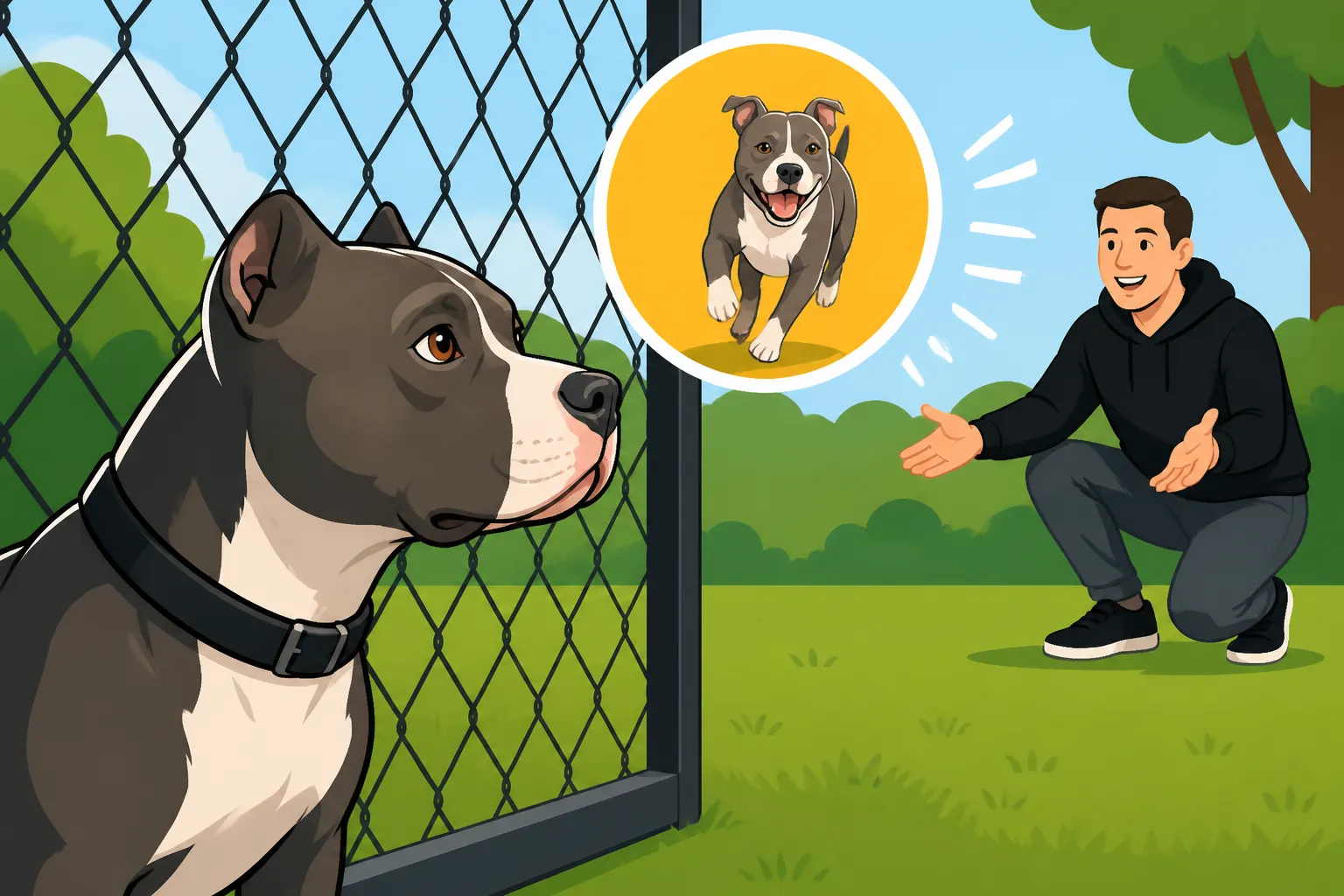
Practicing Pit Bull Recall Behind a Fence
One of the biggest anxieties for Pit Bull owners is the thought of their powerful, driven dog bolting off-leash, especially when a strong distraction appears. Many of us have felt that heart-stopping moment when our dog catches a scent or spots a squirrel, and suddenly, all our calls seem to fall on deaf ears. This guide is all about building a rock-solid recall foundation in the safest possible environment: your securely fenced yard, giving you peace of mind and your Pit Bull the freedom to run.
Why a Fenced Yard is Non-Negotiable for Pit Bull Recall Practice
Let's be real, practicing recall with a powerful, fast, and often highly prey-driven dog like a Pit Bull in an unfenced area can feel like playing Russian roulette. The stakes are simply too high. A secure fence isn't just a convenience; it's a vital safety net that allows you to train without the constant fear of your dog dashing into traffic, disappearing after wildlife, or having an unwanted interaction with another dog or person. It removes countless variables, letting you focus solely on teaching your dog to come when called, reliably and happily.
The Safety Net Against High Prey Drive
Pit Bulls, by their very nature and history, often possess a strong prey drive. That darting squirrel, the neighbor's cat, a rabbit disappearing into the bushes – these can be irresistible lures. In an open space, once that instinct kicks in, it can be incredibly difficult to break through. You might have the best bond in the world, but instinct is a powerful force. A fence means that even if your Pit Bull ignores your call in a moment of pure focus on a fleeing critter, they can't actually go anywhere dangerous. This allows you to interrupt the behavior, re-engage them, and reinforce the correct response (coming to you) without the terrifying consequences of them being truly loose. This controlled environment is where you build the muscle memory for recall. We know that Pit Bulls often get less benefit of the doubt than other breeds, so preventing any incident is paramount.
Minimizing Distractions for Focused Learning
Imagine trying to learn a new language in the middle of a bustling carnival. That's what asking a dog to recall in a highly distracting public park can be like, especially for a young or unpracticed Pit Bull. Your fenced yard, however, is your quiet classroom. While it still offers some distractions (the usual smells, maybe a bird in a tree), it largely eliminates the unpredictable elements that make public recall so challenging: other dogs, unfamiliar people, loud noises, and endless new scents. By starting in a low-distraction environment, you set your Pit Bull up for success. Each successful recall builds confidence in both you and your dog. It teaches them that responding to your call is always the most rewarding option, even when there are other interesting things happening nearby.
Building Confidence for Both Handler and Dog
Let's be honest, trying to teach recall in a wide-open space with a dog that has a tendency to bolt can be incredibly stressful for us as owners. That stress can translate down the leash to your dog, making training less effective. When you're constantly worried, your body language changes, your voice might be tense, and your timing could be off. Within the safe confines of a fence, you can relax. This allows you to be more patient, more consistent, and more generous with your praise and rewards. Your Pit Bull will pick up on your calm confidence, making them more receptive to learning. It's a positive feedback loop: you feel more confident, your dog feels more confident, and the training becomes more enjoyable and effective for everyone involved. It's about building a strong partnership where trust is the cornerstone, which is fundamental when considering something like The Advice Experienced Pit Bull Owners Give.
Setting Up Your Fenced Yard for Recall Success
Before you even utter the "come" command, making sure your training environment is truly safe and conducive to learning is key. This isn't just about having any fence; it's about having the right fence and the right gear to ensure no unexpected escapes or unnecessary frustration.
Securing Your Perimeter
First and foremost, inspect your fence. Is it high enough? Pit Bulls can be surprisingly agile and athletic. A six-foot fence is generally recommended. Look for any gaps or weak spots, especially near the ground. A determined Pit Bull might try to dig under, so reinforcing the base of the fence with chicken wire or buried pavers can be a smart move. Check gates to ensure they latch securely and can't be pushed open. Even a small opening can be an irresistible invitation for adventure. The goal is to create an escape-proof bubble where you can trust that your dog will remain contained, no matter how exciting that butterfly or scent trail might seem. Think of it as a crucial step in preventing a situation where you might wonder Why a Pit Bull Should Not Be Off Leash in Public.
Essential Gear for Effective Training
You don't need a lot of fancy equipment, but what you do use should be reliable.
- High-Value Treats: This is perhaps the most critical item. Your Pit Bull needs to associate coming to you with something absolutely amazing. Think small, soft, smelly treats like cooked chicken, cheese, hot dogs, or store-bought soft training treats. These are far more exciting than kibble, especially when competing with outdoor smells. Consistency with high-value treats is what makes recall irresistible. You can find a huge variety of options on Amazon, or even get inspiration for making your own High-Value Treats That Hold a Pit Bull's Focus.
- A Long Line: Even in a fenced yard, a long line (15-30 feet) can be invaluable, especially in the early stages or if your yard is large. It gives you a physical backup if your dog decides to ignore your call, allowing you to gently guide them back to you without chasing them (which often turns into a fun game for the dog, but not a successful training exercise for you). Ensure it's made of durable material and has robust hardware that can withstand the strength of a pulling Pit Bull. Brands like Ruffwear or even generic options found on Amazon often have strong long lines. Remember that even though you're in a contained space, you need Long Line Hardware That Holds a Pit Bull that won't fail.
- Durable Collar/Harness: Use a well-fitting, secure flat collar or a harness your Pit Bull cannot slip out of. Avoid choke chains or prong collars for recall training, as they can create negative associations with coming to you. A comfortable, secure harness is often a great choice for a strong dog.
- Excitement and Praise: Don't underestimate the power of your own enthusiasm! Your voice, your body language, and your joyful praise are all part of the reward. Make coming to you feel like the best party ever.
Progressive Recall Training Steps in a Fenced Yard
Recall training is a journey, not a single event. It requires patience, consistency, and gradually increasing difficulty. Start simple, make it fun, and build on success.
Step 1: The "Party Here" Game
Begin with zero distractions. Your Pit Bull should be relatively calm and attentive. Start very close to you, maybe just a few feet away. Get down to their level, open your arms, and use your chosen recall word (e.g., "Come!" or "Here!"). Make your voice excited and happy. As soon as your dog takes a step towards you, start praising enthusiastically and back away a step or two, making yourself more appealing. The moment they reach you, jackpot them with several high-value treats and lots of happy physical affection (if they enjoy it). The key is to make coming to you the most wonderful thing that has ever happened. Repeat this many times in short, fun sessions throughout the day.
| Training Phase | Distance from Dog | Distraction Level | Key Focus | Reward Strategy |
|---|---|---|---|---|
| Foundation | 2-5 feet | Low (none initially) | Building positive association with recall word | High-value treats, enthusiastic praise, happy body language |
| Increased Distance | 10-20 feet | Still low | Reinforcing the command from further away | Jackpot treats, celebratory praise, play if desired |
| Minor Distractions | Varying | Toys, scents, slow movement | Practicing override of mild interest | Higher value treats, extreme excitement, quick release |
| Advanced Scenarios | Full yard | Family members, minor noises | Testing reliability under controlled challenges | Top-tier treats, extended play, varied rewards |
Remember to keep sessions short and sweet, ending on a high note. Always use your special recall word only when you are confident your dog will respond. If they seem distracted, get closer or use their name first to get their attention, then give the recall command.
Step 2: Adding Distance and Gentle Distractions
Once your Pit Bull is consistently rocketing to you from a few feet away, gradually increase the distance. Start walking further away before calling them, or call them from across the yard. Still keep distractions low. As they get more reliable, you can start introducing very minor distractions. This might be:
- Having another family member stand quietly in the yard.
- Tossing a low-value toy a short distance away before calling them, and rewarding heavily when they choose you over the toy.
- Calling them when they are mildly sniffing something interesting on the ground (but not deeply engrossed).
The trick is to keep these distractions manageable so your dog still succeeds. If they fail, the distraction was too high. Go back a step. This systematic approach helps in Building a Pit Bull's Impulse Control. You want them to understand that the reward for coming to you always outweighs the reward of whatever they might be doing. Consider using a program like BAXTER & Bella, which often has structured modules for building recall in a progressive manner, providing guidance on how to introduce distractions responsibly.
Step 3: Integrating the "Touch" Command and "Check-ins"
A great way to reinforce recall and make it a fun game is to teach a "touch" command, where your Pit Bull touches their nose to your hand. This gives them a clear target when they come to you. Start close, reward heavily for a nose touch, and then gradually increase distance. This also helps with The Word That Stops a Pit Bull Mid-Stride as it gives them a very specific action.
Beyond formal recalls, encourage "check-ins" in the yard. Every time your Pit Bull voluntarily looks at you, comes over for a quick pet, or passes by, reward them with a calm "good boy/girl" and maybe a small treat. This reinforces the idea that paying attention to you is always a good thing, even when you haven't explicitly asked for anything. It builds a habit of awareness and connection. The more your Pit Bull checks in with you naturally, the more likely they are to respond when you give a formal recall command, even if they are occupied with something intriguing, like chasing squirrels.
Troubleshooting Common Recall Challenges
Even in a fenced yard, you might encounter bumps in the road. Pit Bulls are intelligent and can be stubborn or easily distracted. Don't get discouraged! These challenges are normal, and there are ways to work through them.
When Your Pit Bull Ignores You
It's frustrating when you call, and your Pit Bull looks at you, wags their tail, and then goes right back to sniffing that fascinating patch of grass. If your dog is ignoring you, it's usually for one of a few reasons:
- Low Value Reward: Are your treats exciting enough? If they're choosing a dead leaf over your treat, your treat isn't high-value enough. Elevate your treat game!
- Too Many Distractions: Is there something overwhelmingly interesting? A squirrel just ran up the tree, a neighbor's dog is barking, or a new smell has captivated them. If this happens, reduce the distraction. Get closer to your dog, use a happy, excited tone, and try again. Don't repeat the recall command endlessly; it just teaches your dog that it's optional. Instead, go get your dog, bring them back, and then try again from a closer distance with less distraction.
- Negative Association: Have you ever called your dog only to do something unpleasant, like give them a bath or end a fun play session? Dogs remember. Always try to make coming to you a positive event. If you need to end play, go to your dog, leash them, and then calmly go inside, rather than using your recall command as an "end of fun" signal.
- Your Tone: Are you sounding bored, angry, or frustrated? Your Pit Bull is sensitive to your emotions. Keep your voice light, happy, and inviting.
If your Pit Bull is truly ignoring you even with high-value treats and low distractions, consider going back to using a long line in the yard. This allows you to gently reel them in, ensuring they physically respond to your call, and then rewarding them for that physical response. This way, you prevent them from practicing the habit of ignoring you.
Overcoming Environmental Distractions
A fenced yard isn't always a sterile environment. Birds, squirrels, neighborhood children, distant sirens, or even the smell of barbecue from next door can all be powerful distractions. This is where gradual exposure and consistent reinforcement come into play.
- Start Small: If your dog is easily distracted by birds, start practicing recall when there are no birds visible. Then, move to when a bird is perched far away. Gradually work up to calling them when a bird is actively flying nearby.
- Change Locations: Even within your yard, different spots can have different levels of distraction. Practice near the fence line where smells are stronger, then in the middle of the yard.
- Active Distraction Training: Have a family member walk across the yard with a squeaky toy or toss a ball (not to the dog, but near them) while you call your Pit Bull. Reward heavily when they choose you. This is a controlled way to mimic real-world distractions.
- Use the "Look at Me" Command: Before calling for recall, get their attention with a "look at me" command. Reward for eye contact, then immediately give your recall command. This helps them disengage from the distraction and focus on you. This is an important part of Training a Pit Bull to a Higher Standard Than Other Dogs.
Remember, your goal is not to eliminate all distractions from your dog's life, but to teach them that your call is the most important thing, even when exciting things are happening around them. With enough consistent practice in your safe, fenced yard, you'll build a recall that stands up to most everyday challenges.
Transitioning to Public Areas (With Caution)
Once your Pit Bull has a 99% reliable recall in your fenced yard with various distractions, you might feel tempted to try it in an open park. Do not do this without a long line. The leap from a fenced yard to a truly open, unpredictable environment is huge. Always start in a new, minimally distracting public space on a long line (15-50 feet, depending on the space and your comfort). This gives you the control you need while allowing your Pit Bull more freedom.
Consider places like large, empty sports fields during off-peak hours, or quiet, secluded trails. Keep your expectations realistic. Your dog's recall reliability will likely drop significantly when you move to a new, more stimulating environment. Go back to basics: start close, reward heavily, and gradually introduce more distractions.
Always be aware of your surroundings, and never take your Pit Bull off-leash in areas where breed-specific legislation might be in place or where it could cause distress to others. Building a strong foundation in your yard with positive reinforcement will make any future steps much safer and more successful for you and your amazing Pit Bull. Consistent practice, even for a well-trained dog, is key to maintaining a reliable recall throughout their life.
Disclaimer
This article is for general informational purposes only and does not constitute professional advice. Laws, prices and regulations vary by location and change over time. Consult a qualified professional for guidance on your specific situation.