How Often a Pit Bull Puppy Should Eat
Your new pit bull puppy inhales every meal in seconds, then stares at you like they have not eaten in days. Is that hunger, habit or a sign you are feeding at the wrong times? Puppy feeding charts on bags are vague, and advice from friends rarely agrees. This guide explains how often a pit bull puppy should eat at each age, how much to give, and how to adjust as your puppy grows.
A Feeding Schedule by Age
Pit bull puppies grow fast. A dog that weighs a few pounds at eight weeks may be 40 to 60 pounds of muscle by its first birthday. That growth needs steady fuel, and how often you feed matters as much as what you feed. Small, frequent meals keep blood sugar stable, reduce stomach upset and make house training more predictable.
The Short Answer
| Age | Meals Per Day | Why |
|---|---|---|
| 8 to 12 weeks | 4 | Tiny stomach, rapid growth, steady blood sugar |
| 3 to 6 months | 3 | Stomach capacity increases, growth still rapid |
| 6 to 12 months | 2 | Growth begins to slow, routine settles |
| 12 to 18 months and beyond | 2 | Adult pattern, transition to adult food |
Most pit bulls do best on two meals a day for life. A single daily meal is not usually recommended for this breed, because it leaves a long gap that can make some dogs ravenous and anxious around food, and it increases the volume in the stomach at once. Our guide to Two Measured Meals a Day for a Pit Bull explains why the twice-daily pattern sticks.
Eight to Twelve Weeks: Four Meals a Day
When your puppy first comes home, usually around eight weeks, their stomach is small and their energy needs are high. Four meals spread across the day, roughly every four to five hours while you are awake, works well. A typical schedule might be 7 a.m., 11 a.m., 3 p.m. and 7 p.m.
At this age, puppies can be prone to low blood sugar, especially smaller or underweight pups from a shelter or rescue. Signs include weakness, trembling, wobbliness and lethargy. Frequent meals reduce that risk. If you see these signs, contact your vet right away.
Many new owners worry about feeding the last meal too late. Aim to feed the final meal two to three hours before bedtime so your puppy has time to digest and go outside before sleeping. That makes overnight house training much easier.
Three to Six Months: Three Meals a Day
Around 12 weeks, most pit bull puppies are ready to move to three meals a day. The total daily amount still increases as they grow; you are simply dividing it into larger, less frequent portions. A typical schedule is 7 a.m., noon and 5 or 6 p.m.
This is also the teething stage, from about three to six months. Some puppies eat less enthusiastically when their gums are sore. Softening kibble with warm water for a few minutes can help. If your puppy skips a single meal but is otherwise playful, it is usually not a concern; if they refuse food for a full day, see A Pit Bull That Refuses Food for a Day.
Six to Twelve Months: Two Meals a Day
By six months, many pit bulls can move to two meals a day, morning and evening. Some owners keep a small midday meal until eight or nine months, especially for very active puppies or those who get hungry and pushy around lunchtime. There is no harm in a gradual transition.
Growth slows during this period, but pit bulls are still building muscle and bone. Keep feeding a quality puppy food until your vet says it is time to switch.
Feeding a Rescue or Underweight Puppy
Not every pit bull puppy arrives from a breeder at a tidy eight weeks with a full belly and a feeding log. Many come from shelters and rescues, sometimes underweight, sometimes after a rough start with parasites or an upset stomach. These puppies often need a slightly different approach.
An underweight puppy usually does better on more frequent, smaller meals rather than larger portions. Even a puppy old enough for three meals may benefit from staying on four for a few extra weeks while they regain condition. Large meals in a puppy that has been underfed can lead to vomiting or loose stools, which sets recovery back.
Work with your vet on a target weight and a timeline. A rescue puppy should gain steadily, not dramatically. Deworming, a fecal check and a review of the vaccination record usually come first, because a puppy carrying intestinal parasites will struggle to put on weight no matter how well you feed. Once those basics are handled, most rescue pit bulls catch up quickly and settle into the same schedule as any other puppy.
Feeding When You Work Full Time
Four meals a day sounds simple until you realize you leave for work at 7:30 and get home at 6. Many owners face exactly this problem with a young puppy.
There are several workable options. A family member, neighbor or dog walker can stop by at midday for a meal and a potty break, which also helps house training. Some owners use a timed automatic feeder for one of the meals, although these work best with dry kibble and a puppy that is already eating calmly. Another option is to shift the schedule earlier and later, feeding at 6 a.m., before leaving, right after getting home and again in the early evening, accepting a longer midday gap for a short period.
What does not work well is skipping meals altogether and doubling up later. A puppy that goes ten hours without food and then gets a giant meal is more likely to gulp, vomit and have accidents. If midday coverage is impossible, talk to your vet about how to stretch the schedule safely until your puppy is ready for three meals.
How Much to Feed at Each Meal
How often you feed is only half the question. The other half is how much. Overfeeding a pit bull puppy is common, and a chubby puppy is not a healthy puppy.
Start With the Bag, Then Adjust
Feeding charts on puppy food bags are a starting point. They are usually based on the puppy’s current weight and age, and sometimes on expected adult weight. Divide the daily amount by the number of meals. For example, if the chart says three cups a day for your puppy’s weight and you feed three meals, each meal is one cup.
The chart cannot account for your puppy’s metabolism, activity level, or the calories in treats. You need to adjust based on body condition. Measuring Pit Bull Food Instead of Guessing covers why a proper measuring cup or kitchen scale beats eyeballing.
Reading Body Condition
Body condition scoring is the most reliable way to know whether you are feeding the right amount. A pit bull puppy at a healthy weight should have:
| What to Check | Healthy Puppy | Overfed Puppy | Underfed Puppy |
|---|---|---|---|
| Ribs | Easily felt with light pressure, not visible | Hard to feel under a layer of fat | Clearly visible from a distance |
| Waist from above | Visible tuck behind the ribs | No visible waist, straight or rounded | Very pronounced, bony hips visible |
| Belly from the side | Slight upward tuck | Belly sags or is level with the chest | Sharp tuck, hollow look |
| Energy | Playful, alert, curious | Can be sluggish | Low energy or constantly frantic for food |
Pit bulls are muscular, which can make weight hard to judge. A dense, heavy puppy is not necessarily fat. Use your hands, not just your eyes. Our guide to Why Muscle Makes Pit Bull Weight Hard to Judge explains the difference between muscle mass and fat in this breed.
Calorie Needs Change Fast
A growing puppy may need roughly twice the calories per pound of body weight as an adult dog of the same size. That ratio drops gradually as growth slows. This is why regularly reweighing your puppy and adjusting portions every couple of weeks is important.
A simple routine:
- Weigh your puppy every two weeks, using a bathroom scale by weighing yourself with and without the puppy.
- Check body condition with your hands at the same time.
- Compare the weight against the feeding chart and adjust the daily total.
- Divide the new total by the number of meals you feed.
- Note any changes in a simple log, along with treats and chews.
- Bring the log to vet visits so your vet can review growth trends.
Treats Count Too
Training a pit bull puppy involves a lot of treats, and those calories add up. A common guideline is to keep treats at no more than about 10 percent of daily calories. During heavy training periods, use part of your puppy’s regular kibble as rewards, or choose very small, low-calorie training treats. Where Treats Fit in a Pit Bull’s Calories goes into this in detail.
Choosing the Right Puppy Food
The food you choose shapes how much and how often you feed. A nutrient-dense food may mean smaller portions; a lighter food may need larger ones.
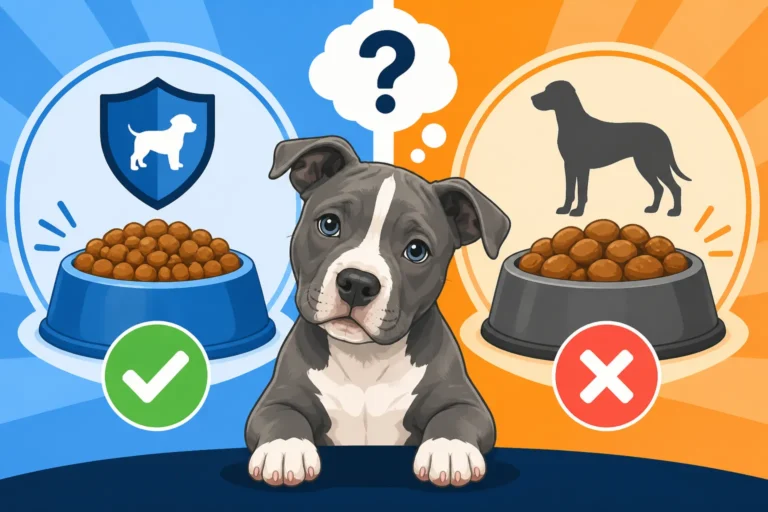
Puppy Formula Versus All Life Stages
Look for a food labeled as complete and balanced for growth or for all life stages, according to AAFCO nutrient profiles. That label ensures the food contains the nutrients a growing puppy needs. Adult maintenance formulas are not designed for puppies and can leave them short on key nutrients.
Pit bulls sit near the line between medium and large breeds. Many adult pit bulls weigh 40 to 60 pounds, and some larger American Bully-type dogs or mixes grow heavier. If your puppy is expected to exceed about 50 pounds as an adult, ask your vet whether a large-breed puppy formula makes sense. Those foods control calcium and calorie density to support steady, rather than rapid, bone growth. Feeding a Pit Bull Puppy to Fifty Pounds walks through that decision.
Kibble, Wet and Fresh Food
| Food Type | Pros | Cons |
|---|---|---|
| Dry kibble | Convenient, affordable, easy to measure | Less palatable for some puppies |
| Wet food | Highly palatable, good hydration | More expensive, spoils quickly once opened |
| Fresh or gently cooked food | Very palatable, minimally processed | Higher cost, needs refrigeration and planning |
| Raw food | Some owners prefer its simplicity | Bacterial risk and balance concerns for puppies |
Fresh-food subscriptions such as Ollie portion meals to your puppy’s weight and age, which can make it easier to stick to a set number of meals. Plans and pricing change, so check the company’s own site for current options. Some owners mix a fresh topper with kibble to boost palatability while keeping cost reasonable.
Many pit bull owners buy kibble and wet food through Chewy, where autoship helps ensure you never run out, and others pick up bags on Amazon. Whichever retailer you use, double-check that the formula on the bag matches what you intended, since many brands sell several similar-looking recipes.
Switching Foods Safely
Switching foods abruptly can cause diarrhea, which is already a common problem in new puppies. If you need to change foods, transition over about a week:
- Days one and two: 75 percent old food, 25 percent new food.
- Days three and four: 50 percent old, 50 percent new.
- Days five and six: 25 percent old, 75 percent new.
- Day seven onward: 100 percent new food.
If loose stools appear, slow the transition down. Persistent diarrhea, vomiting or blood in the stool calls for a vet visit, especially in a young puppy whose vaccination series is not yet complete. Our guide to Pit Bull Puppy Diarrhea in the First Week explains what is normal and what is not.
Routines, Problems and the Move to Adult Food
A consistent feeding routine does more than fill a stomach. It shapes house training, manners and how your puppy relates to food for life.
Free Feeding Versus Scheduled Meals
Free feeding, where food is left out all day, is generally not recommended for pit bull puppies. It makes it hard to track how much they eat, contributes to overweight, makes house training less predictable, and can encourage guarding of a bowl that is always full. Scheduled meals give you control and give your puppy a routine.
Pick up the bowl after 15 to 20 minutes, even if food remains. Your puppy will quickly learn that mealtime has a beginning and an end.
Fast Eaters and Food Guarding
Many pit bull puppies eat very quickly. That can cause gulping air, vomiting and discomfort. Slow-feeder bowls, snuffle mats and food puzzles slow things down and add mental enrichment. These are widely available from Chewy, Amazon and local pet stores.
Some puppies become protective of their food bowl. Address this early and gently. Hand-feeding part of meals, adding a tasty treat to the bowl as you walk by, and never taking the bowl away as a test all help your puppy learn that people near the bowl are a good thing. If guarding is intense, see Pit Bull Food Bowl Guarding and consider a qualified trainer.
Feeding Around Exercise
Avoid heavy exercise for about an hour before and after meals. That habit is a common precaution against stomach upset and bloat-type problems, which are more often associated with deep-chested breeds but are worth respecting with any dog. Feed after a morning walk, then let your puppy rest.
When to Switch to Adult Food
Most pit bulls switch from puppy to adult food between 12 and 18 months of age. Smaller pit bulls may be ready closer to 12 months, while larger dogs or bully mixes may benefit from staying on puppy or large-breed puppy food a little longer. Spaying or neutering can also reduce calorie needs, so expect to adjust portions afterward.
Transition to adult food the same gradual way you would switch any food. Keep feeding two meals a day. For the details, see Moving a Pit Bull Off Puppy Formula.
A Sample Daily Plan
Here is how a day might look for a four-month-old pit bull puppy on three meals:
| Time | Activity |
|---|---|
| 6:30 a.m. | Potty break and short walk |
| 7:00 a.m. | Breakfast, then rest |
| 9:00 a.m. | Short training session using part of the daily kibble |
| 12:00 p.m. | Lunch, potty break |
| 2:00 p.m. | Play and chew time |
| 5:30 p.m. | Dinner, then rest |
| 7:30 p.m. | Final potty break and calm play |
| 9:30 p.m. | Last potty break before bed |
The exact times matter less than consistency. A puppy that knows when food is coming tends to be calmer, easier to house train and more relaxed around mealtimes.
Water, Chews and Extras
Fresh water should always be available, not just at mealtimes. Pit bull puppies play hard and can get thirsty quickly, especially in summer. Keep a clean bowl in the same spot and refill it several times a day. Some owners limit water an hour or two before bedtime during early house training, which is reasonable as long as the puppy drinks plenty during the day.
Chews are part of puppy life, especially during teething, but they also carry calories. Bully sticks, dental chews and similar items can add a surprising amount to the daily total. Count them as part of your puppy’s intake and reduce meal portions slightly on days with heavy chewing. Always supervise chewing and remove pieces small enough to swallow whole.
Household foods are a different matter. Grapes, raisins, onions, garlic, chocolate, xylitol-sweetened products and cooked bones are all dangerous to dogs. A puppy that learns to beg at the table will eventually be handed something risky by a well-meaning guest. Our list of Household Foods That Are Dangerous to a Pit Bull is worth posting on the refrigerator.
Common Feeding Mistakes
Most feeding problems in pit bull puppies come from a handful of predictable habits:
- Feeding by the bag chart alone without checking body condition.
- Using a coffee mug or random scoop instead of a real measuring cup.
- Forgetting to count training treats, chews and table scraps.
- Switching foods suddenly when the store runs out of the usual formula.
- Leaving food out all day and losing track of how much is eaten.
- Moving to adult food too early because the puppy looks full grown.
- Not adjusting portions after spaying or neutering.
Each of these is easy to fix once you notice it. A measuring cup, a weekly weight check and a written schedule on the fridge solve most of them.
When to Call the Vet
Contact your vet if your puppy refuses food for more than a day, vomits repeatedly, has persistent diarrhea, seems weak or lethargic, or is gaining or losing weight unexpectedly. Your vet can also help you set target weights and calorie goals tailored to your individual puppy. Regular checkups during the first year are a good time to confirm that your feeding plan is on track.
Disclaimer
This article is for general informational purposes only and does not constitute professional advice. Laws, prices and regulations vary by location and change over time. Consult a qualified professional for guidance on your specific situation.