The Traits That Get a Dog Called a Pit Bull
It’s a scenario many dog lovers know all too well: you see a dog with a certain look, a particular build, and instantly, a label pops into your head – "Pit Bull." But what exactly are those defining characteristics that trigger this automatic identification, even when the dog might be a mix of several breeds or even something else entirely? This guide will explore the common physical and behavioral traits that lead dogs to be called Pit Bulls, delve into why these perceptions exist, and discuss the complex reality behind the label.
The Distinctive Physical Features Often Labelled "Pit Bull"
When someone points to a dog and declares it a "Pit Bull," they're usually referring to a collection of physical traits that have become synonymous with the type, rather than a single, universally recognized breed. It’s important to remember that Why Pit Bull Is a Type and Not a Breed, meaning there isn't one official "Pit Bull" breed standard, but rather several breeds and mixes that fit the visual archetype.
Head Shape and Musculature
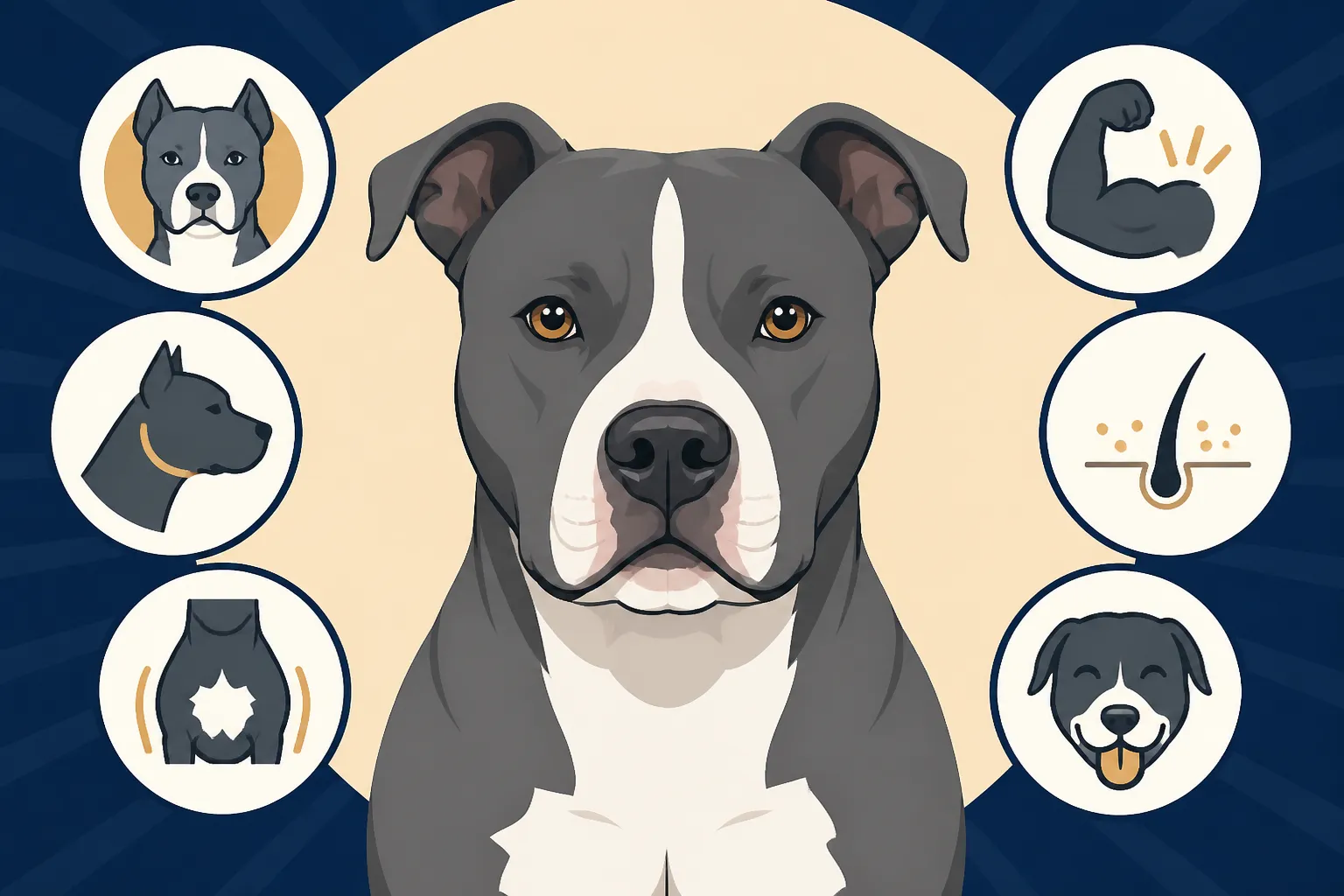
One of the most immediate identifiers is the head. We often associate a Pit Bull with a broad, powerful head, particularly across the cheeks and skull. This isn't just about aesthetics; it speaks to the underlying musculature designed for strength. A dog fitting the "Pit Bull" type typically has strong, well-defined jaw muscles, which contribute to that characteristic blocky or wedge-shaped head. The muzzle is usually medium in length, neither too long and refined nor too short and pushed-in, proportionate to the head's overall width.
People often describe this as a "powerful" or "strong-jawed" look, which can unfortunately feed into certain stereotypes. However, for those of us who adore these dogs, it’s simply a part of their unique, handsome appearance. Their eyes are generally round or almond-shaped, set fairly wide apart, and can come in a huge range of colors, though amber and dark brown are very common.
Body Build and Coat Characteristics
Beyond the head, the body conformation is another key element. Dogs identified as Pit Bulls tend to have a compact, muscular, and athletic build. Think of a powerful, agile physique, with a deep chest, well-sprung ribs, and a strong, slightly arched neck that flows into broad shoulders. They typically possess a short, stiff coat that lies close to the body. This coat can come in virtually any color or pattern imaginable, from solid blacks and whites to brindle, fawn, blue, red, and pied.
The overall impression is one of solid strength and agility, a dog built for activity and power. This athletic frame means they need consistent exercise to stay healthy and happy, and their short coat generally makes grooming fairly straightforward, though they do still shed! You'll often find owners stocking up on grooming supplies at places like Chewy to keep their dog's coat gleaming. Pit Bull Height, Weight and Build can vary quite a bit, even within the same type, so seeing a range of sizes that all get called "Pit Bull" is completely normal.
Jaw Structure and Bite Appearance
The perception of a "locking jaw" is a persistent myth that contributes to the fear surrounding Pit Bull-type dogs. However, from a biological standpoint, no dog breed possesses a jaw that can "lock" in place. What these dogs do have, like many breeds developed for gripping or holding, are powerful jaws with strong bite forces and an incredible will to hold onto something once they've engaged. Their Pit Bull Head Shape and Jaw Structure is designed for strength, and their teeth are well-suited for tearing and crushing.
When people describe a "Pit Bull" bite, they're often observing the intensity and determination of the dog, rather than a unique anatomical feature. This tenacity, when misdirected or untrained, can be formidable. However, in a well-socialized and trained dog, it translates to incredible focus during play, excellent grip during tug games, or determination in working roles. It's a trait that requires responsible management and training, but isn't inherently dangerous.
Behavioral Hallmarks and Misconceptions
Beyond physical traits, certain behavioral characteristics, whether real or perceived, also contribute to a dog being labeled a Pit Bull. These often stem from the breed's history and unfortunately, widespread misconceptions.
Energy Levels and Drive
Pit Bull-type dogs are generally high-energy animals with a strong drive. They were historically bred for tasks requiring stamina, strength, and determination, and those traits are still very much present today. This means they often need a significant amount of physical exercise and mental stimulation to prevent boredom and destructive behaviors. A daily walk around the block might not cut it for many of these dogs; they thrive on vigorous play, running, fetching, or engaging in dog sports.
Their drive can manifest in various ways: a strong prey drive (a natural inclination to chase small, fast-moving objects), intense focus during training, or relentless enthusiasm for a game of tug. Owners often find themselves constantly seeking new ways to channel this energy productively. Many use puzzle toys or enrichment activities ordered from online retailers like Chewy to keep their intelligent dogs engaged, especially on days when outdoor exercise is limited.
Perceived Temperament and Socialization Needs
Public perception often paints Pit Bulls as inherently aggressive, a narrative that ignores the true Pit Bull Temperament and What Testing Shows. In reality, well-bred and properly socialized Pit Bull-type dogs are known for being affectionate, loyal, and incredibly people-friendly. They often show a remarkable tolerance for children and a desire to please their human companions. However, like any powerful dog, they require consistent and early socialization to become well-adjusted adults.
Early and ongoing exposure to a variety of people, places, sounds, and other calm, well-behaved dogs is crucial. Without it, any dog can develop fear or reactivity. The challenge for Pit Bull owners is that their dog’s natural exuberance and strength, combined with public biases, mean that even well-meaning interactions can be misconstrued. Therefore, teaching impeccable manners and ensuring positive public experiences from a young age is paramount.
Canine Aggression vs. Dog Selectivity
One of the most misunderstood behavioral traits associated with the Pit Bull type is their potential for dog selectivity, sometimes mistakenly called "dog aggression." Historically, these dogs were bred to be tenacious with other animals in the ring, but gentle with humans. While individual temperament varies greatly, some Pit Bull-type dogs may mature into being selective about their canine companions, meaning they may not thrive in every dog park scenario or multi-dog household. This isn't necessarily human-directed aggression, but rather a preference for certain dogs, or even a complete intolerance for unknown dogs.
It's a nuanced distinction: a dog that is dog-selective can be perfectly well-behaved and safe around people, but might need careful management and supervision around other dogs. This trait demands responsible ownership, including secure leashes, proper introductions, and sometimes, a "no dog parks" policy. Understanding Pit Bull Dog Selectivity and Multi-Dog Homes is key to preventing incidents and ensuring everyone's safety, including the dog's.
The Influence of Media and Public Perception
Unfortunately, the "Pit Bull" label carries a heavy burden of societal perception, heavily influenced by media portrayal and historical narratives. This often shapes how people interpret the physical and behavioral traits of these dogs, regardless of the individual dog's reality.
Visual Stereotypes and Instant Identification
The media has played a significant role in creating a powerful visual stereotype of the "Pit Bull." Images of muscular, short-coated dogs, often with intense expressions, are frequently used to accompany news stories about dog attacks, even when the breed involved is not actually a Pit Bull type, or is a mix. This constant exposure has ingrained a mental image in the public consciousness, making visual identification seem straightforward, even when it’s far from accurate.
This instant, often negative, identification can lead to significant problems for owners. A family dog that perfectly fits the physical description of a "Pit Bull" might face unwarranted fear or prejudice purely based on its appearance. This is why it's so frustrating for dedicated Pit Bull owners who know their loving, goofy companion is nothing like the sensationalized image. The visual traits, therefore, become a double-edged sword: admired by those who love the type, and feared by those who don't.
The Impact of Breed-Specific Legislation
The persistent negative perception of Pit Bulls has directly led to Where Pit Bull Legislation Still Applies in various cities and counties, often in the form of breed-specific legislation (BSL). These laws are typically based on perceived breed and physical appearance, attempting to regulate or ban dogs that fit the "Pit Bull" profile. This is often the real-world consequence of these traits being so easily identified and demonized.
BSL often dictates everything from mandatory muzzling in public to outright bans on ownership, forcing loving families to move or rehome their pets. This highlights how profoundly public perception, fueled by a focus on certain physical traits, can impact the lives of countless dogs and their human companions. It’s a frustrating cycle where physical traits lead to a label, which then leads to discriminatory laws, despite evidence often showing these laws are ineffective at improving public safety.
The "Nanny Dog" Myth and Its Modern Repercussions
On the flip side of the negative stereotype, there's the often-cited "nanny dog" myth, which claims Pit Bulls were historically known for their gentle nature with children. While Pit Bull-type dogs can be incredibly loving and patient with children, like any dog, they are animals and require supervision. Why the Pit Bull Nanny Dog Story Is a Myth and relying on it without proper judgment is irresponsible.
The repercussions of this myth, when taken literally, can be dangerous if it leads owners to be complacent about supervision. While we celebrate the affectionate nature of these dogs, it's crucial to remember that their powerful build and high energy mean that proper management, training, and supervision around children are non-negotiable, just as they would be for any large, active breed. The goal is to celebrate their wonderful qualities responsibly, without falling for romanticized, unproven claims.
Why Visual Identification Isn't Always Accurate
The biggest pitfall of relying on "the traits that get a dog called a Pit Bull" is that visual identification is notoriously unreliable. What one person calls a Pit Bull, another might see as a completely different breed or mix.
The Blurring Lines of Mixed Breeds
The term "Pit Bull" encompasses a range of distinct breeds, primarily the American Pit Bull Terrier, the American Staffordshire Terrier, and sometimes the Staffordshire Bull Terrier. Beyond these, countless mixed-breed dogs, often with no recent Pit Bull ancestry, exhibit physical traits that lead people to label them as such. A dog might have a broad head from a Boxer ancestor, a muscular build from a Bulldog, and a short coat from a Labrador, and suddenly, it's a "Pit Bull" in the eyes of many. Which Mixed Breed Dogs Get Called Pit Bulls is a topic of constant discussion and often leads to misidentifications.
This blurring of lines is a huge challenge, especially for shelters and rescues trying to place dogs. A dog that is 100% Labrador might be labeled a "Pit Bull mix" if it has a blockier head or a stocky body, immediately affecting its chances of adoption due to housing restrictions or public bias. The truth is, unless you have reliable pedigree information or a DNA test, it's often a best guess, and sometimes, not a very good one.
DNA Testing vs. Visual Guesswork
In an era of advanced genetics, we have tools that can tell us a dog's true ancestry. DNA Testing Against a Shelter Pit Bull Label has repeatedly shown that visual identification of breeds, particularly for Pit Bull types, is incredibly inaccurate. Studies have found that shelter staff, even experienced ones, often incorrectly identify breeds, especially when a dog carries traits associated with Pit Bulls. A dog visually identified as a "Pit Bull" might only have a small percentage of American Pit Bull Terrier or American Staffordshire Terrier in its DNA, or none at all.
This isn't a criticism of shelter workers, who do an incredible job under difficult circumstances, but a testament to how superficial appearances can be deceiving. The actual genetic makeup of many dogs commonly labeled as Pit Bulls is often a complex tapestry of multiple breeds. Relying solely on a visual impression can lead to significant errors, perpetuating misconceptions and impacting a dog's welfare.
The Consequence of Mislabeling
The casual act of labeling a dog a "Pit Bull" based on observed traits carries profound consequences. It can affect a dog's chances of adoption, its ability to live in certain apartments or cities, and even its eligibility for homeowners insurance. When a dog is mislabeled, it can unfairly become subject to breed-specific laws or social prejudice, simply because it looks the part. How Often Shelter Staff Agree on a Pit Bull Label highlights the subjectivity and inconsistency in these designations.
Ultimately, focusing on the "traits that get a dog called a Pit Bull" shifts the conversation away from responsible ownership, training, and individual temperament, and places it squarely on appearance. Instead of asking what breed a dog "looks like," perhaps a more productive question would be: "What is this individual dog's temperament, and what are its needs?" This approach moves us towards evaluating dogs as individuals, rather than pre-judging them based on a set of broad and often misleading visual cues.
Here’s a quick overview of how common traits are often interpreted:
| Trait Category | Specific Trait | Common Perception/Label | Underlying Reality/Nuance |
|---|---|---|---|
| Physical | Broad, blocky head | "Pit Bull head" | Common across many bully breeds & mixes |
| Muscular, stocky build | "Strong Pit Bull body" | Shared by numerous athletic dog breeds | |
| Short, stiff coat | "Classic Pit Bull coat" | Also found in Labs, Boxers, many mixes | |
| Powerful jaws | "Locking jaw," dangerous bite | No such thing as a "locking jaw"; strong jaws are common | |
| Behavioral | High energy & drive | "Aggressive," "uncontrollable" | Needs appropriate outlet; can be highly trainable |
| Tenacity in play/tug | "Stubborn," "won't let go" | Reflects strong will, focus, can be trained | |
| Dog selectivity | "Dog aggressive," "can't be around other dogs" | Varies by individual; requires careful management | |
| Affection towards people | "Nanny dog," or surprising for "Pit Bull" | Many are very people-oriented and friendly |
Understanding the specific traits that lead to a dog being called a Pit Bull helps us to see the bigger picture: that these are often subjective interpretations influenced by history, media, and our own biases. It underscores the importance of looking beyond the label and seeing the individual dog in front of us.
Disclaimer
This article is for general informational purposes only and does not constitute professional advice. Laws, prices and regulations vary by location and change over time. Consult a qualified professional for guidance on your specific situation.