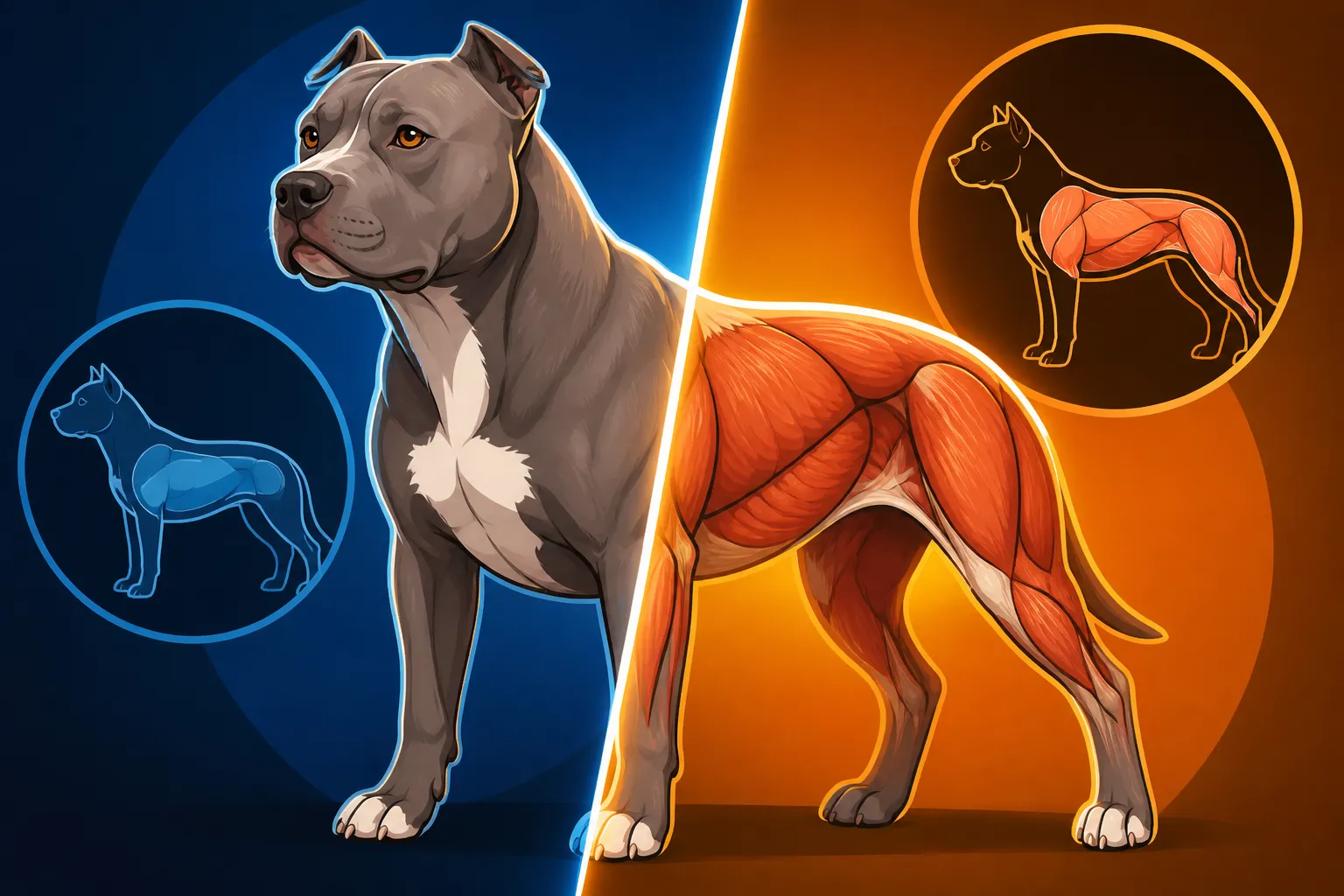
Reading Pit Bull Body Condition Under Muscle
It can be incredibly challenging for Pit Bull owners to accurately gauge their dog's weight. Their naturally muscular build often hides both excess fat and underlying leanness, leaving many of us wondering if our beloved blockheads are truly at a healthy body condition. This guide is here to cut through that confusion, helping you confidently assess your Pit Bull's physique, understand what to look for beyond the impressive muscles, and ensure they're on the path to optimal health and longevity.
Understanding the Pit Bull Physique
Pit Bulls are known for their strong, athletic builds, dense musculature, and often short, sleek coats. This combination creates a powerful appearance that can make it deceptively difficult to assess their true body condition. Unlike a fluffy breed where a little extra padding is obvious, a Pit Bull can carry a surprising amount of fat hidden beneath those impressive muscles, or conversely, appear perfectly healthy when they are actually a bit underweight for their frame.
The Athletic Build vs. Carrying Extra Weight
Many Pit Bulls are natural athletes, built for power and endurance. Their breed type suggests a sturdy, compact dog with well-defined muscles. When you look at a healthy Pit Bull, you should see definition, but not necessarily a bony appearance. The challenge comes when owners or even well-meaning acquaintances mistake general bulk for lean muscle. A Pit Bull carrying extra weight might still look "solid," leading people to think they're in great shape, when in reality, that solidity comes from a layer of fat over the muscle. This extra weight puts unnecessary strain on their joints and overall health. For a deeper dive into what a healthy working frame looks like, consider Pit Bull Weight and Muscle on a Working Frame.
Imagine two Pit Bulls: one, a working dog with daily rigorous exercise and a perfectly balanced diet; the other, a beloved couch potato who gets daily walks but also a few too many high-calorie treats. Both might appear strong and muscular at first glance. However, upon closer inspection and, more importantly, a hands-on examination, the differences in their body fat percentage would become clear. The couch potato Pit Bull might have a broader, less defined waist, and a softer feel over their ribs, while the working dog will feel tight and toned.
Visual Cues That Can Be Misleading
Visual assessment alone can be incredibly deceptive with Pit Bulls. Their deep chests and well-sprung ribs can sometimes make them look more barrel-chested than they are, giving the impression of robust health even if they're a little thin. On the other hand, a slightly overweight Pit Bull might still have a visible athletic shape due to its inherent muscle, masking the extra pounds that are accumulating around their middle or over their hips. Without understanding what to look for, owners might inadvertently contribute to issues like Pit Bull Obesity and Joint Strain.
For example, a Pit Bull with a "blue nose" coat color might have slightly less dense fur, making their ribs appear more prominent even if they're at an ideal weight. Conversely, a stockier American Staffordshire Terrier type might naturally have a broader chest and slightly less defined waist, making it harder to discern if they're carrying extra fat visually. You really need to get your hands on them. The trick is to look beyond just the silhouette and feel what's underneath. What feels like a solid wall of muscle might, upon palpation, reveal a squishier layer of fat, especially around the base of the tail or over the hips.
The Hands-On Approach to Body Condition Scoring
Because visual assessment alone is often insufficient, the most reliable way to determine your Pit Bull's body condition is through a hands-on examination, or palpation. This involves feeling different areas of your dog's body to assess the amount of fat covering their bones. It takes practice, but once you know what to feel for, it becomes second nature and is a crucial part of your regular health check routine.
Feeling for Ribs, Spine, and Hip Bones
Start by gently running your hands along your Pit Bull's sides, specifically over their rib cage. You should be able to feel their ribs individually, much like feeling the knuckles on your hand, without having to press hard. If you can see the ribs clearly without touching them, your dog might be too thin. If you have to press firmly to feel them, or can't feel them at all, they're likely carrying too much weight. This sensation is a critical indicator of Telling Muscle From Fat on a Pit Bull.
Next, move your hands along their spine. You should be able to feel the bumps of their vertebrae without seeing them protrude excessively. Again, a slight cover is good, but thick padding indicates excess fat. Finally, feel for their hip bones. Just like the ribs, they should be easily palpable but not sharply jutting out. Imagine you're doing a mini-exam, feeling for the subtle nuances. A healthy Pit Bull will have just enough fat to give a smooth, streamlined appearance, but not so much that it obscures the underlying skeletal structure. Regular palpation during grooming, perhaps when you're giving them a good brush (you can find plenty of robust brushes on Chewy or Amazon), can help you get familiar with what feels "normal."
Assessing the Waist and Abdominal Tuck
After checking the ribs, spine, and hips, it's time to step back and look at your Pit Bull from above and from the side. From above, you should see a distinct "waist" where the body narrows behind the rib cage, before widening slightly again over the hips. If your Pit Bull looks like a straight line from chest to tail, or if the area behind the ribs bulges outwards, they're likely overweight.
From the side, observe their abdominal tuck. A healthy Pit Bull should have an abdomen that tucks up slightly behind the rib cage, rather than hanging low or being straight across. This tuck indicates good muscle tone and an appropriate body fat percentage. If their belly sags or has no tuck, it suggests abdominal fat accumulation, even if their muscles are prominent. This combination of visual and tactile cues gives you a much clearer picture than simply looking at their impressive musculature. Think of it like this: if you're having trouble distinguishing the waist and tuck, it's a good sign that your dog might be carrying more than just lean muscle, a concept explored further in Why Muscle Makes Pit Bull Weight Hard to Judge.
The Body Condition Score BCS System for Pit Bulls
Veterinarians and animal nutritionists use a standardized Body Condition Score (BCS) system to assess an animal's fat reserves. This system typically uses a 9-point scale, where 1 is severely underweight, 9 is severely obese, and 4-5 is considered ideal. For muscular breeds like Pit Bulls, understanding how to apply this scale correctly is essential, as their unique physique can make typical BCS charts a little tricky to interpret at first glance.
Interpreting BCS Charts for Muscular Breeds
When looking at a standard BCS chart, you'll see descriptions and illustrations of dogs at various body conditions. For a Pit Bull, aiming for a 4 or 5 on a 9-point scale is generally the goal. At a BCS of 4, you should be able to easily feel the ribs, spine, and hip bones with minimal fat covering, and there should be an obvious waist and abdominal tuck. At a BCS of 5, the ribs are still easily palpable, but with a slight fat cover, and the waist and tuck are still clearly evident. The key is "easily palpable" – you shouldn't have to search for the bones, but they shouldn't be sticking out dramatically either.
A Pit Bull at BCS 6 or higher will start to show a decreasing waistline, ribs that are harder to feel, and less of an abdominal tuck. At a BCS of 7 or more, fat deposits will be noticeable over the lumbar area and the base of the tail, and there will be no waist or tuck. It's about finding that sweet spot where muscle definition is clear, but there's a healthy, minimal layer of fat. If you're comparing your Pit Bull to other dogs in a park, remember that not all dogs are at their ideal weight, and a healthy Pit Bull might look "thinner" than an overweight one, even if both are muscular.
Ideal Scores and What They Mean
An ideal BCS of 4-5 means your Pit Bull has the optimal balance of muscle and a healthy fat reserve. This is the condition where they can perform their best, whether that's zooming around the yard, enjoying a long hike, or just being comfortable on the couch. It also means they're less likely to suffer from weight-related health issues, which can range from joint problems to certain metabolic diseases. Maintaining this ideal score is part of responsible ownership and contributes significantly to their overall well-being and lifespan.
A Pit Bull at an ideal BCS will typically have:
- Ribs that are easily felt but not seen (or only very faintly seen in certain lighting).
- A palpable spine and hip bones with a thin layer of muscle and fat.
- A distinct waist when viewed from above.
- An abdominal tuck when viewed from the side.
- Visible muscle definition without being "ripped" or bony.
Here's a simplified table to help you interpret a Pit Bull's body condition:
| BCS (9-point scale) | Ribs | Waist (from above) | Abdominal Tuck (from side) | General Appearance |
|---|---|---|---|---|
| 1-2 (Too Thin) | Ribs, spine, hip bones easily visible/sharp | Extremely exaggerated, hollow | Severe, sunken abdomen | Muscle loss, gaunt |
| 3 (Underweight) | Ribs easily felt, minimal fat, some visible | Clearly visible, marked | Obvious | Lean, might lack some muscle mass |
| 4-5 (Ideal) | Easily felt with slight fat cover | Distinct and proportional | Clearly present | Well-proportioned, athletic, muscle definition |
| 6 (Overweight) | Ribs felt with moderate pressure | Less distinct, beginning to fill in | Less noticeable | Rounder appearance, slightly heavier |
| 7-9 (Obese) | Difficult/impossible to feel | Absent or bulging | Absent, pendulous | Bulky, heavy fat deposits over body, no definition |
Reaching and maintaining this ideal BCS requires attention to The Calorie Target for a Lean Pit Bull and consistent exercise.
Common Pitfall: Mistaking Muscle for Fat and Vice Versa
It's a really common mistake, even for seasoned dog owners, to misinterpret a Pit Bull's body shape. Their impressive musculature can create illusions that lead us astray when trying to assess their weight. We often assume that a strong-looking dog is a healthy-weight dog, and that's not always the case.
The Illusion of "Bulky" Being Healthy
Many Pit Bull owners, myself included at times, can fall into the trap of thinking "bulky" equals "healthy" or "strong." We see their wide chests and powerful legs and associate it with peak condition. However, a Pit Bull that appears excessively bulky might actually be carrying an unhealthy amount of fat under that muscle. This fat can hide quite well, especially if the dog is still reasonably active. The additional weight might not be immediately obvious because their strong frame can support it, but it's silently stressing their joints and internal organs.
This misconception is especially prevalent with certain "Pit Bull types" that are bred for extreme muscle mass, where the line between muscle and fat can blur. A dog might look impressive and powerful, like it could win a weight-pulling competition, but if you can't easily feel their ribs, or if their waist is non-existent, they are likely overweight. This extra bulk can lead to issues down the road, making topics like Joint Support for a Heavily Muscled Pit Bull even more critical. It’s crucial to remember that a truly healthy, muscular dog will still be lean beneath the muscle, not just generally large.
When a Lean Pit Bull Looks Too Thin to the Untrained Eye
Conversely, a Pit Bull at an ideal, lean body condition might actually look "too thin" to someone accustomed to seeing overweight dogs. Because they lack a thick fur coat, their musculature and bone structure are more visible. When you see a healthy Pit Bull with a clearly defined waist and a good abdominal tuck, some might mistakenly think they are underweight or not being fed enough. This can lead to well-meaning but misguided advice to "feed them more" when they are actually at their prime.
This is where your hands-on assessment becomes your best friend. A Pit Bull whose ribs are easily felt but not sharply visible, and who has clear muscle definition, is likely in excellent condition. This is particularly true for dogs that get plenty of exercise and are Feeding a Pit Bull for Lean Muscle. Don't let external perceptions sway you from maintaining your dog's optimal lean weight. Trust your hands, your knowledge of the BCS system, and your veterinarian's advice. What appears "skinny" to some is often perfectly healthy for an active, athletic Pit Bull.
Practical Steps for Monitoring and Adjustment
Once you understand how to assess your Pit Bull's body condition, the next step is to make this a regular practice. Consistency in monitoring and being proactive with adjustments to their diet and exercise routine are key to maintaining their ideal weight throughout their life. It's an ongoing journey, not a one-time check.
Regular Checks and Documentation
Make a habit of performing a hands-on BCS check at least once a month, ideally more often if you suspect any changes. This can be incorporated into your regular grooming routine or during cuddle time. Pay attention to how their ribs, spine, and hip bones feel, and observe their waist and tuck. It’s a good idea to record your findings, perhaps jotting down a quick note in a journal or on your phone. This creates a historical record that can help you spot trends. For example, you might notice your dog's ribs becoming harder to feel as the seasons change or if their activity level decreases.
If you have a digital scale at home, weighing your Pit Bull monthly can also provide objective data, especially for subtle changes. Remember that the absolute number on the scale isn't as important as their body condition, but seeing trends can be very helpful. If you consistently find yourself struggling to feel ribs that were once easy to palpate, or if their waist seems to disappear, it's a clear signal that it’s time to make some changes. This regular vigilance is crucial for issues like A Pit Bull Gaining Weight on the Same Food.
Adjusting Diet and Exercise Based on BCS
If your Pit Bull's BCS starts to creep up (e.g., from a 5 to a 6), the first areas to examine are their diet and exercise. Are they getting too many treats? Has their exercise routine become less rigorous? Even small adjustments can make a big difference. If they're slightly overweight, consider reducing their daily food intake by a small percentage, perhaps 5-10%, or swapping out high-calorie treats for healthier, low-calorie options like carrot sticks or green beans. Many brands carried by Chewy, for example, offer lower-calorie options specifically for weight management, or you might look into fresh food options like Ollie that provide precisely portioned meals.
Conversely, if your Pit Bull is a bit too lean (BCS 3), you might need to slightly increase their food portion or offer a higher-calorie, nutrient-dense food. It's also important to ensure their exercise is adequate – a Pit Bull needs consistent activity to build and maintain lean muscle mass. For comprehensive guidance on their energy needs, check out Pit Bull Exercise for a Powerful Athletic Dog. Always make dietary changes gradually over several days to avoid upsetting their stomach. The goal is to find the right balance that keeps them at their ideal BCS without drastic fluctuations.
When to Seek Professional Guidance
While you can do a lot on your own to monitor your Pit Bull's body condition, there are times when professional veterinary input is not just helpful but absolutely necessary. Don't hesitate to reach out to your vet if you're struggling to maintain an ideal weight or if you notice any sudden, unexplained changes.
Persistent Weight Issues and Underlying Health Concerns
If, despite your best efforts at adjusting diet and exercise, your Pit Bull consistently remains overweight or underweight, it's time for a vet visit. Persistent weight issues can sometimes be a symptom of an underlying medical condition, such as a thyroid imbalance or metabolic disorder. For instance, a Pit Bull gaining weight even when their food intake hasn't changed might be showing signs of Hypothyroidism and a Thinning Pit Bull Coat. Your veterinarian can perform a thorough examination, including blood tests if necessary, to rule out any medical reasons for the weight imbalance.
Sometimes, what looks like a dietary issue could be linked to something else entirely. For example, allergies can cause inflammation and discomfort, sometimes leading to changes in appetite or activity levels. A veterinarian can help you understand the full picture and address any health concerns that might be contributing to a weight problem. They can also provide a more objective BCS assessment and tailor recommendations specifically for your individual dog, considering their age, activity level, and any pre-existing conditions. As your dog ages, these check-ups become even more important; see How Often a Ten Year Old Pit Bull Needs Checking.
Working with Your Veterinarian for a Tailored Plan
Your veterinarian is your best partner in ensuring your Pit Bull's long-term health. If you're unsure about your dog's BCS, bring it up at your next routine check-up. They can demonstrate how to properly perform a hands-on assessment and confirm if your interpretation is correct. If adjustments are needed, they can help you create a tailored plan for diet and exercise. This might involve recommending specific prescription diets available through your vet or online retailers like Chewy, suggesting supplements, or even referring you to a canine nutritionist for more complex cases.
They can also provide guidance on appropriate exercise levels, especially if your Pit Bull has any joint issues or other physical limitations. For example, if your Pit Bull has undergone a surgery like a cruciate ligament repair, your vet will advise on the safest way to Getting a Pit Bull Back Into Condition without overstressing healing tissues. It's a team effort, and your vet has the medical expertise to ensure your Pit Bull not only looks great but is truly healthy from the inside out. They can help you factor in things like Adjusting Pit Bull Food After the Neuter or managing a dog with chronic conditions.
Disclaimer
This article is for general informational purposes only and does not constitute professional advice. Laws, prices and regulations vary by location and change over time. Consult a qualified professional for guidance on your specific situation.